
Stridhan & Woman's Property Rights
Topic Overview
1. Stridhan- Woman ‘s Property & Succession
2. General Provisions Relating to Succession
1. Stridhan- Woman ‘s Property
When a Hindu female dies intestate, it means she dies without leaving a valid will. In such cases, the distribution of her property is governed by Sections 15 and 16 of the Hindu Succession Act, 1956. Unlike the succession rules for a Hindu male, the Act provides a separate order of succession for females.
- Section 14 – Property of female Hindu to be her absolute property
- Property of a woman acquired before or after commencement of this act, women will be held as full owner and not limited owner.
- Earlier, women had absolute right only on Stridhan, that devolved among her and on other property, she has limited rights only up to lifetime. And after her death, the property is devolved amongst the heir earlier, full owner
- Property - Moveable and Immoveable, Acquired by Inheritance, devise, partition or by lieu of maintenance, by gift by relative or not, by her own skill or Stridhan
Mangal Singh vs Ratu
Hindu widow was in position of land belonging to her husband in 1970 which was illegally disposed by collateral of husband in 1954 brought suit for possession during pendency Act was enacted and subsequently in 1958.
JUDGEMENTCourt held that as women was absolute owner of property U/S 14 of Hindu Succession Court hence legal representative have right to succeed the property
- Section 15 – General Rule of Succession in case of female Hindu
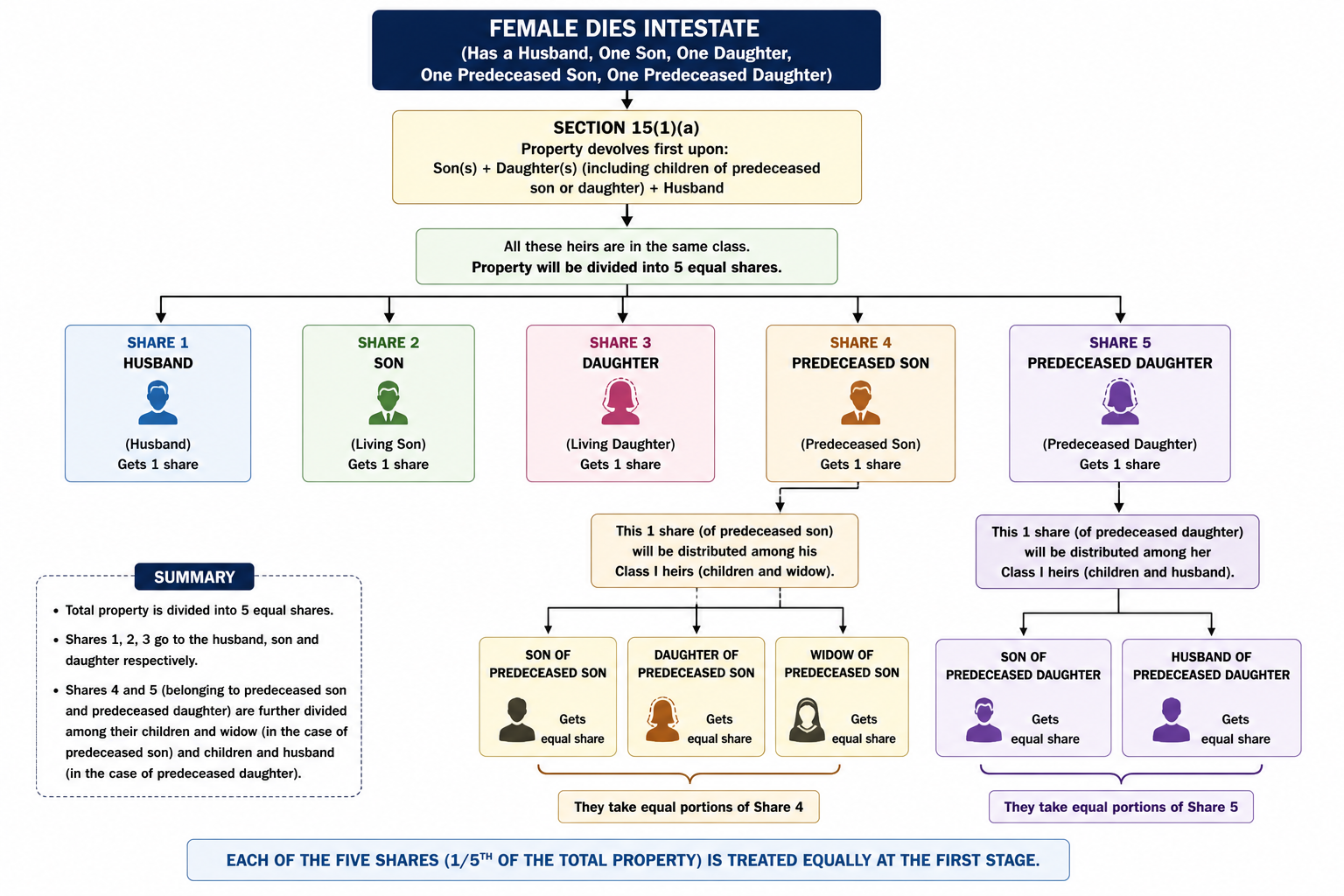
a) Firstly - Sons, daughter, children of predecessor child and husband.
b) Secondly – Heirs Of husband
c) Third – Mother & Father
d) Fourthly – Heirs of Father
e) Fifthly – Heirs of Mother
- If a Hindu female inherited property from her father or mother and she dies without leaving any son, daughter, or children of a predeceased son or daughter, then that property does not go to her husband's heirs. Instead, it goes to the heirs of her father. example: A inherits a house from her father. She dies without husband, son, or daughter. The house will go to her father's legal heirs (e.g., brother, sister, etc.), not to her husband's family.
- If a Hindu female inherited property from her husband or father-in-law and she dies without leaving any son, daughter, or children of a predeceased son or daughter, then that property does not go to her parents' heirs. Instead, it goes to the heirs of her husband.
- Example: A inherits agricultural land from her husband. She dies without children. The land will go to her husband's legal heirs, not to her parents or their heirs.
Ayi Ammal V. Asari
K died intested in July 1960. She was widow of P. Her father had gifted her some property. She sold jewels lent amount of interest upon her Some outstanding dues and some promissory note. K’s sister claims that K’s property was a gift from her father, hence she is entitled to get her property.
JUDGEMENTCourt held that property could not be set to have been inherited by K. Hence Devolution under section 15. And one and higher surface wind shall take property.
- Section 16 – Order of Succession
- Rule 1 – Entry rise of fires under section 15.
- Rule 2 - if intestate have Pre deceased, son or daughter, Who have children those children shall take share between them as deceit would have taken if living.
- Rule 3 - If the property of a Hindu female goes to the heirs of her husband, father, or mother, then it will be distributed according to the same succession rules that would have applied if that husband, father, or mother had died intestate (without a will).
General Provision
The General Provisions Relating to Succession under Sections 18 to 29 of the Hindu Succession Act, 1956 lay down the common rules that govern inheritance after the legal heirs have been identified. These provisions deal with matters such as preference between full blood and half blood, the mode of distribution among heirs, the rights of a child in the womb, disqualifications from inheritance, and the devolution of property when no legal heir exists
- Section 18 – Full blood Preferred over half blood.
- Heirs related to by full blood shall be preferred to hirs by half blood, if nature of relationship is same in every subject
Illustration - brother by full blood is preferred to brother by half blood, but brother by half-blood will be preferred to Son of brother by half blood. Because brother is nearer higher than brother’s son
Example: A married X had two children, B and C. X died A remarried Y had 1 child D. C married W, and had children C1 and C2. If B dies, his property allotted to C at first instance If C also dies, B’s property shall be allotted to D and C’s children
- Similarly, paternal uncle by half blood is preferred to son of paternal uncle Section 20 right of child in whom child who was in womb at time of death and born alive has same right to inherit that he would have been by full blood - Section 19 – Modes of succession
- When two or more heirs inherit together, they take the property:
- In equal shares (per capita), and
- As tenants-in-common, meaning each heir owns a separate share. - Section 20 - Right of child in Womb
- who was in womb at time of death and born alive, have same right to inherit that He would have been before death of interstate. - Section 21 – Presumption in case of simultaneous death
- when two died intestates. It cannot be found who died first. It is presumed that younger survivor Elder.
- Example in case of accident. - Section 22 – Presumption in cases of simultaneous death
- if a person dies without a will and two or more Class I heirs inherit the property, and one heir wants to sell his/her share, the other Class I heirs have the first right to buy it.
Example: A's wife, son, and daughter inherit a house. The son wants to sell his share. The wife and daughter get the first chance to buy it.
- If the heirs cannot agree on the price, the Court decides the price. If the buyer refuses to buy after the Court fixes the price, the buyer has to pay the court costs.
Example: The son asks ₹20 lakh, but the daughter offers ₹15 lakh. The Court fixes the correct price.
- If more than one Class I heir wants to buy the share, the heir who offers the highest price gets it.
Example: Wife offers ₹18 lakh. Daughter offers ₹19 lakh. The daughter gets the share because she offered the higher price - Section 25 – Murder Disqualified
- Any person Who commits murder or abets murder with intention to inherit property of disease shall be disqualified. - Section 26 – Convert’s descendants disqualified.
- When a person converted to another religion and ceased to be Hindu, children born after Conversion are disqualified to inherit ancestral properties. - Section 28 – Disease defects, etc, do not disqualify.
- Earlier, if any vulnerable disease, or if descendant is mentally or physically ill, they would be disqualified. Disqualification on such ground is now removed. - Section 29 – Failure of hires
- if no hires, then the property is dwelled to government. But if it must come with liability and obligation, and this is also known as doctrine of escheat - Section 30 - Testamentary succession
- Any Hindu can dispose of his or her property by making a valid will, according to the provisions of the Indian Succession Act, 1925 and other applicable laws.