
A detailed study of Hindu Adoption and Maintenance Act, 1956
Topic Overview
Part I: Adoption
Sections 5–17 – Structural rules, capacity, conditions, and legal consequences of adoption.
Part II: Maintenance
Sections 18–30 – Statutory obligations and rights for wives, widows, children, parents, and dependants.
Introduction and Nature of the Act
The Hindu Adoptions and Maintenance Act, 1956 (HAMA) is one of the four major Acts enacted as part of the Hindu Code Bills to codify and modernize Hindu personal law. It came into force on 21 December 1956 and applies to Hindus, Buddhists, Jains, and Sikhs.
The Act regulates the law relating to adoption and maintenance, providing uniform legal rules regarding who can adopt, who may be adopted, the conditions for a valid adoption, the legal effects of adoption, and the rights to maintenance of wives, children, aged parents, widowed daughters-in-law, and other dependants.
The Act aims to protect the welfare of children and ensure financial support to persons who are legally entitled to maintenance.
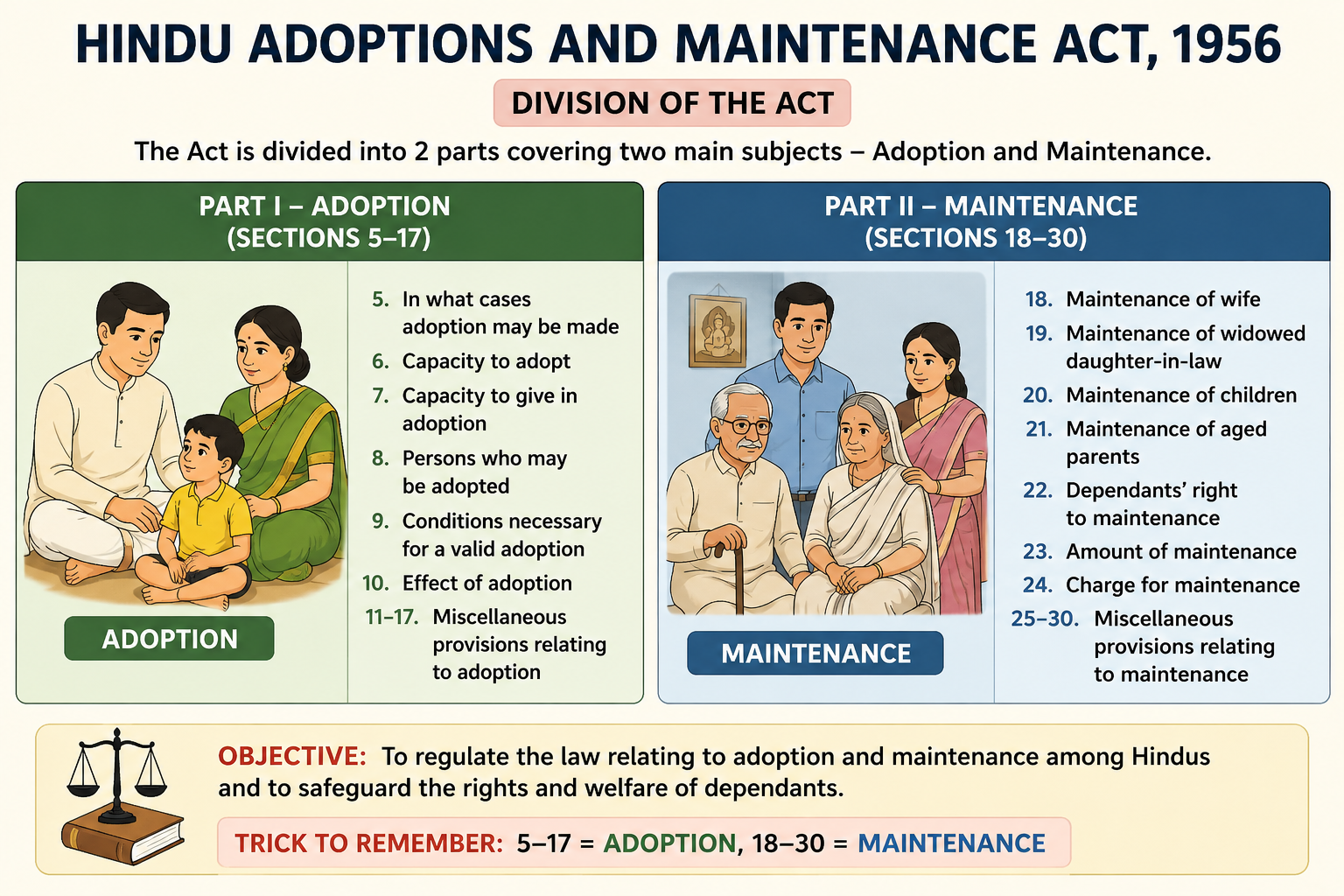
Sections 5–17
Adoption (Chapter II)
Section 18–30
Maintenance (Chapter III)
a. Adoption
The Hindu Adoptions and Maintenance Act, 1956 (HAMA) codifies the law relating to adoption among Hindus. Before the enactment of this Act, adoption was mainly governed by customs and religious practices. HAMA brought uniformity by laying down clear legal provisions regarding who can adopt, who can give a child in adoption, who may be adopted, the conditions for a valid adoption, and the legal effects of adoption.
A valid adoption under the Act creates a permanent parent-child relationship, and the adopted child is deemed to be the child of the adoptive parents for all purposes, enjoying the same rights and obligations as a natural-born child.
Provision for Adoption are Under Section 5- 17(Chapter II)
Section 5 - Adoptions to be regulated by this Chapter
After the commencement of the Hindu Adoptions and Maintenance Act, 1956, every adoption by or to a Hindu must be made according to the provisions of this Act. If the adoption does not comply with the Act, it is void (invalid).
Essential element of Valid Adoption provided U/s 6 – 11
Section 6 – Requisites of valid adoption.
- A person taking adoption should have capacity to do so
- Person giving adoption has capacity to do so
- Person adopted is capable of being adopted
- Other conditions.
Section 7- Capacity of male Hindu to take in adoption.
Should be of sound mind and not minor. If married, consent of wife, if multiple wife, consent of all wife. But if wife has renounced the world, declared incompetent by court, converted, no need of consent
Section 8 – Capacity of Female Hindu to take in adoption
Sound mind and major. if Married consent of husband required. But if husband has 1) renounced the world, 2) Converted 3) Unsound mind, - no need or consent
Section 9- Person capable of giving adoption
No person except father, mother, Guardian, has capacity to give adoption. Parents, biological parents, both parents have equal right to give children adoption, but with consent, unless one parent has renounced the world, converted or declared unsound by competent court.
Guardian person having care of child or both of his parent’s property Include 1) Guardian appointed by parents through will 2) Gaurdian appointed by government that is de facto guardian Does not have right to give an adoption
Where 1) both parents are dead, 2) both parents renounce the world, 3) abandon the child, 4) declared unsound. In such cases, guardian of child may give child an adoption to any person, including himself
Before granting permission to guardian court shall satisfy that:
- adoption will be for welfare of child.
- Consider wish of child regard to age and understanding.
- Applicant for permission has not received or agreed to receive any payment or reward in consideration of such adoption. If any reward exchange considered as sale of child
Section 10 – who may be adopted.
Person to be taken in adoption shall be:
- Hindu,
- Not already adopt
- Not married unless custom and Usage permit to adopt a married person
- Not complete age of 15 unless customer use it permit.
Section 11 – Other conditions of valid adoption.
Every adoption following condition must be complied.
- 1. Adoption of son - adoptive parents must not Have a Hindu son, son’s son, son’s son’s son living at time of adoption
- 2. Adoption of daughter - adoptive parents must not have Hindu daughter, son’s daughter, living at time of adoption.
- 3. Female adopting male - adoptive mother at least 21 years older than person to be adopted.
- 4. Male adopting female - adoptive father at least 21 years older than Person to be adopted
- 5. Same child cannot be adopted simultaneously by two or more person.
- 6. There should be actual given and taking of Child
A child adopted from orphanage, having no information about patronage, shall be adopted under juvenile Justice Act.
General provision of adoption. From section 12 to 17
Section 12 – Effect of adoption
All rights of a child from his birth family are replaced by the right of adoptive family. But it shall be carried forward in case of
I) Marriage - Child cannot marry any person whom he or she Could not marry if he or she would have continued to be in birth family
II) Vested obligated – If child has any property vested with him before adoption, shall continue to own property and also subject to such obligation.
Section 13 – Rights of adoptive parents to dispose their property
Unless there is an agreement attempt to parents continues their power to dispose of their property by transfer or by will.
Section 14 – Determination of adoptive mother in certain cases.
Hindu male with a wife adopts a child. She will be adopted mother
when adoption has been made with consent of more than one wife. The senior most among the marriage shall be adoptive mother.
Widower or bachelor adopts a child. Any wife he marries after adoption shall be stepmother of adoptive child.
Widow or unmarried woman adopts a child any husband. She marries after adoption shall be stepfather.
Section 15 - Valid adoption cannot be cancelled.
In traditional law, adoption could not be cancelled. Now, no adoption can be cancelled by adoptive parents nor Nor child can renounce status by returning to birth family.
Section 16 – Presumption as to register document relating to adoption.
If registered document is presented to court signed by both giving and taking party, the court will presume the adoption was validly made under this act
Section 17 – Prohibition of certain payment
No person shall receive, give or agree to receive or agree to give any payment or reward in consideration of adoption. If done, punishable with imprisonment, which may extend up to 6 months or with both
4. Maintenance: Traditional Rights and Rights under Hindu Adoption & Maintenance Act1956.
Maintenance is the legal obligation to provide financial support and the basic necessities of life, such as food, clothing, residence, education, and medical care, to persons who are unable to maintain themselves.
Under traditional Hindu law, the right to maintenance was based on religious and moral duties, with the family head being responsible for maintaining dependants. To bring uniformity and legal certainty, the Hindu Adoptions and Maintenance Act, 1956 (HAMA) codified these principles and converted many moral obligations into legally enforceable rights.
The Act specifies the rights of wives, widowed daughters-in-law, children, aged parents, and other dependants to claim maintenance and lays down the circumstances and extent of such maintenance
Provision for maintenance is provided Under section 18 to 30
Section 18 – Maintenance of wife
1) Hindu married woman before or after commencement of the act is entitled to maintain by her husband throughout her life.
It is your personal right against her husband. Arises irrespective of fact whether husband property, either ancestral or self acquired.
Section 39 of transfer of property act Provides that wife is entitled to be maintained out of husband’s property.
Obula Konda Reddy vs C. Pedda Venkata Lakshmana
Question arises whether wife of void marriage can claim maintianece under U/S 18.
JUDGEMENTCourt held that Word Hindu wife i Interpreted to mean wife, whether valid or void marriage. It means wife whose marriage is solemnised, though void she shall be entitled to claim maintenance from husband.
2) Hindu wife shall be entitled to live separately with her claim to maintain if condition laid down in section 18(2) are fulfilled
A) Desertion By husband
In Desertion wife has to prove following fact.
a) Husband has abandoned her.
b) He has done so without any reasonable cause, without consent against her wish.
c) He is guilty of wilfully neglecting her
desertion can be done even if they are living in same house.
Neelam Singh v. Vijay Narayan Singh
Husband was a Bank Manager. He did not keep his wife with him, asked her to live in the village, and failed to provide a proper standard of living.
JUDGEMENTThe Court held that the husband's conduct amounted to desertion. The wife was justified in living separately and was awarded ₹1,000 per month as maintenance.
PRINCIPLEA wife can claim maintenance if the husband deserts her or fails to provide a reasonable standard of living. The amount of maintenance depends on the husband's income, circumstances, and the parties' lifestyle.
desertions include wilful neglect of spouse. Neglect means neglect in discharge of marital obligation Meyer neglected is not sufficient. It should be wilful negligence
B) Cruelty by husband.
Cruelty is set to be conducted of such characters That caused danger to life limb or Health.
Cruelty can be bodily battery or beating can also be mental words of insult and humiliation.
Suit for maintenance on ground of cruelty.
a) Wife has to prove husband treated her with cruelty.
b) Cruelty was such to cause reasonable apprehension in her mind that it will injuries to life or limb if she lives with her husband
Cruelty not necessarily physical violence should be used, but continuous ill treatment, cessation of marital intercourse, neglect
Threat of physical force to pregnant wife.
Cruelty not define in act, but it means Conduct Complaint grieve enough that wife cannot live with husband
C) Husband suffering from Virulent from Leprosy
Wife entitled to separate residents and maintenance on ground that husband is suffering from leprosy And it was omitted in 2019
D) Husband having another wife
Wife entitled to claim maintenance and separate residents if her husband has another wife living
Right Would not occur to wife if marriage is void under Hindu Marriage Act
E) Husband keeping a concubine.
To claim separate residents and maintenance necessary for wife to prove a) husband keeps concubine b) concubine lives in same house in which married Wife
Keeping concubine Permanently, not a casual act of prostitution.
Concubine is a woman permanent and exclusively keeping of a man not married to her.
Keshav Bhai vs Hariban
High court held that husband keep mistress in same house in which his wife living or where he resides habitually with Concubine Indicate wrong behaviour of married man.
F) When husband ceased to be Hindu by conversion
Wife is entitled to maintenance and separate residents if her husband abandon Hinduism
Mere fact husband converted doesn’t break marriage Wife under section 13 Of Hindu marriage act can file divorce.
Right to claim maintenance would continue as long as wife remains Hindu
illustration A and B were husband and wife. A converted to another religion B have right to claim maintenance but where B also cease to be Hindu, her right would cease to exist.
G) Other justifying causes.
Empower Court to give Hindu wife a relief that those cases which not mention in other class Very wide scope ground of domestic bickering compatibility minor differences.
3) A Hindu wife not entitled to write off maintenance from her husband if she is unchaste or she is to be Hindu
Section 19 – Maintenance of widow daughter in law.
Hindu wife, whether married before or after the commencement of the act, shall be maintained by her father-in-law after husband’s death till she not able to maintain herself out of own earning or other property from a state of husband, father, mother.
Obligation and father-in-law seize on remarriage of daughter in law.
Widow daughter in law cannot claim Right if Able to maintain herself by:
a) own earnings
b) estate of husband,
c) estate of father,
d) estate of mother
e) from son,
f) from daughter
g) estate of son
h) estate of daughter
i) If she remarries
j) she ceased to be Hindu
Section 20 – Maintenance of aged informed parents and children.
Hindu is bound during his or her lifetime to maintain legitimate, illegitimate children aged parents
Legitimate illegitimate child can claim maintenance if child is minor.
Obligation to maintain parents or daughter Extends as far as parents or daughter not able to maintain themselves
Section 21- Dependence defined
Dependence of disease to claim maintenance from heir of deceased Dependence means the following relative of deceased
| Dependants | Extends in which deemed to be dependants |
|---|---|
| i. Father | Throughout his life. |
| ii. Mother | Throughout her life. |
| iii. Widow | As long as not able to maintain herself or remarry. |
| iv. a) son b) son of Predeceased son c) son of Predeceased son of deceased son |
a) As long as minor b) to extend where he is unable to obtain maintenance from his parents’ estate and as long as he is minor. c) As long as minor to extend unable to maintain from a state of parent or grandparents |
| v. widowed Daughter | If unable to maintain from husband’s estate, Son and daughter are their estate, Father-in-law or his estate. |
| vi. a) Any widow of Son b) Any widow of son of his pre deceased son |
a) As long as does not remarry and unable to maintain from husbands’ estate, son or his estate daughter, or her estate c) As long as does not remarried and unable to maintain from husband’s estate, son or his estate daughter, or her estate Father in law or his estate |
| vii. Minor illegitimate son | As long as minor |
| viii. Illegitimate daughter | As long as she remains unmarried |
Section 22- Maintenance of dependence
Dependent of deceased are entitled to maintain by heirs of deceased out of estate inherited by them. Liability to maintain is limited to estate of deceased,
where dependent has not obtained any share in instead of disease. By testimony or interstate succession, no obligation to be maintained
Liability of each person taking share from such a state is proportionate to share.
Section 23 – Amount of maintenance
If maintenance would be awarded to why children are aged or infirm parents a) Position and status of Parties b) Reasonable wants of claimant c) Whether claimant is justified if living separately, d)value of claimants, property and any income derived from it or from his own earnings of form any other sources e) Number of persons entitled to maintain its
To Determine the amount of maintenance to be awarded following shall be considered a) Net value of state after payment of debt. b) Provision, if made by deceased, will in respect of dependent c) degree of relation between 2 d) reasonable wants of dependent e) Value of property of dependent and income derived from such property or own earning or other sources. f) Number of dependents entitled for maintenance
Section 24 – Claimant Should be a Hindu
A person cannot claim maintenance under HAMA if he or she converts to another religion. Conversion ends the right to claim maintenance under this Act.
Section 25 – Alteration of Maintenance
The amount of maintenance can be increased or decreased if there is a material change in circumstances. Applies whether maintenance was fixed by court decree or agreement.
Section 26 - Debts Have Priority
The debts of the deceased must be paid before the dependants' claim for maintenance.
Section 27 – Maintenance as a Charge
A dependant's maintenance is not automatically a charge on the deceased's property. It becomes a charge only if created by:
- Will
- Court decree
- Agreement
- Any other legal method
Section 28 – Effect of Transfer of Property
If the property is transferred: The dependant can claim maintenance from the transferee if: the transferee knew about the maintenance right, or the transfer was without consideration (gift).
The dependant cannot claim against a bona fide purchaser for value who had no notice of the maintenance right.