
Hindu Succession Act, 1956
Topic Overview
1. Devolution of Coparcenary & Male Intestate Succession
2. Stridhan, Woman's Property & Female Succession
3. General Provisions & Disqualifications Relating to Succession
1. Overview & Succession to a Hindu Male
The Hindu Succession Act, 1956 is one of the most important laws in Hindu personal law. It governs how the property of a Hindu person is inherited after their death, whether they die with a will or without one. Before this Act, inheritance rules were based on ancient customs and differed between schools like Mitakshara and Dayabhaga, often leading to inequality, especially against women. The Act brought uniformity and fairness to succession laws. A major milestone came with the 2005 Amendment, which granted daughters equal coparcenary rights in ancestral property, placing them on par with sons. Understanding this Act is essential for every law student because it forms the foundation of inheritance and property rights under Hindu law.
Introductory provisions:-
- Section 5 – Act not applicable to certain property
· Property regulated under the Indian Succession Act because of the provisions of Section 21 of the Special Marriage Act.
· Property which descends to a single heir by the terms of any agreement entered into by the ruler of any Indian State with the Government of India before the commencement of this Act. - Section 6 – Devolution of interest in coparcenary property
· After the commencement of the Hindu Succession Act and its subsequent Amendment in 2005, daughters became coparceners and gained the same rights and liabilities as a son.
· Females are now absolute owners of their property.
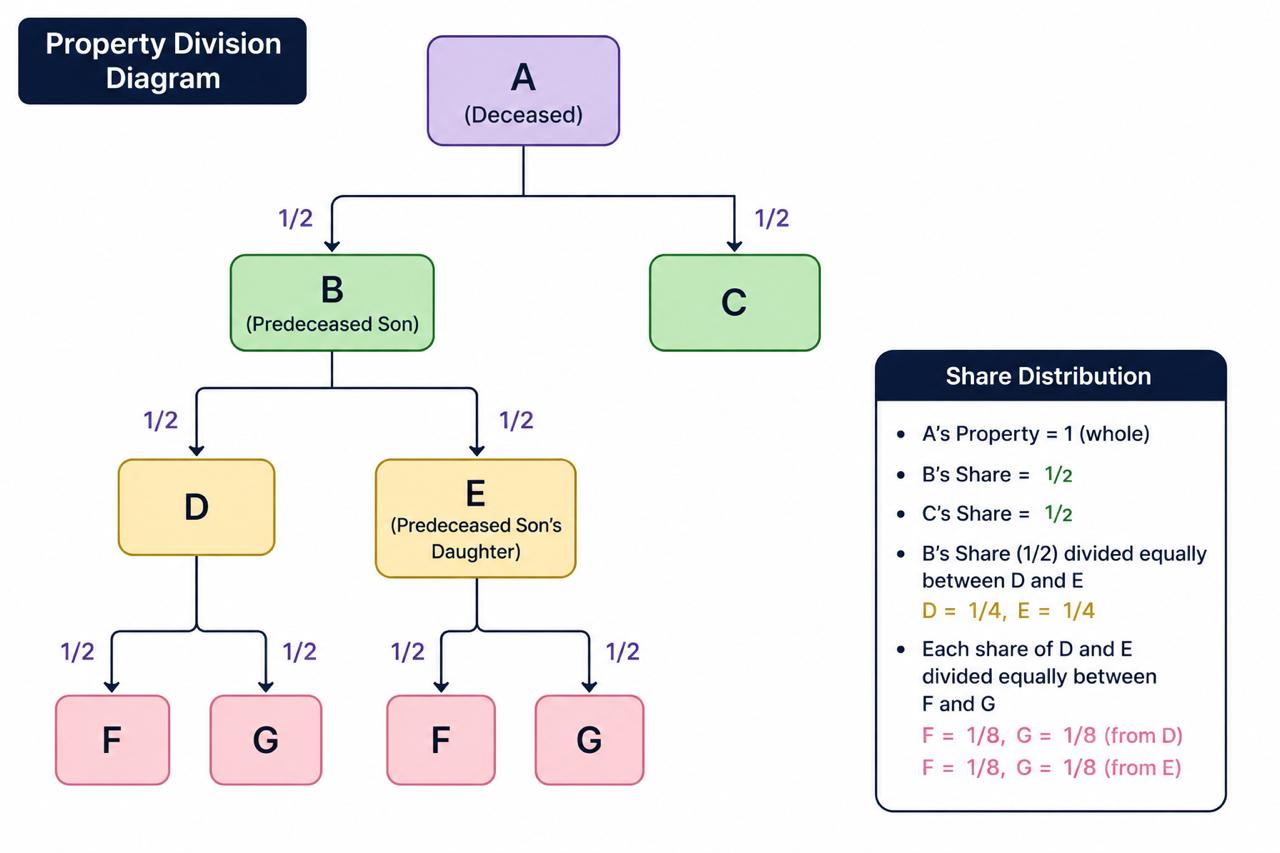
Historical Context: Under the traditional Mitakshara school, no property rights were granted to women. Under the Dayabhaga school, women held property rights but were not absolute owners; they could enjoy the property throughout their lifetime but had no right to dispose of it during or after their life. - Abolition of the rules of survivorship, which were practiced in the Mitakshara School, after the Amendment Act of 2005. Property should be divided in the same manner as in a partition:
i) A daughter has the same share as a son.
ii) The share of a predeceased son/daughter is given to their children.
iii) The share of a predeceased child of a predeceased child is allotted to their surviving children.
- · Abolition of the doctrine of pious obligation: no recovery can be made from a son, grandson, or great-grandson for any debt after the commencement of the 2005 amendment. If the debt was contracted before the commencement of the Act, the son, grandson, and great-grandson remain liable to pay.
- · Nothing in this section applies to a partition which was executed before 20th December 2004.
If a Hindu male dies intestate, it means he dies without making a valid will for the distribution of his property. In such cases, his property is distributed according to the rules laid down in the Hindu Succession Act, 1956, mainly under Sections 8 to 13.
a) Heirs specified in Class I
b) Heirs specified in Class II
c) Agnates
d) Cognates
- Section 9 – Order of Succession among heirs in the Schedule
· Class I heirs inherit simultaneously to the exclusion of all others.
· Class II heirs inherit entry-wise (heirs in Entry I exclude heirs in Entry II, and so on).
· Class II heirs are entirely excluded if even a single heir of Class I is present. Succession is based upon the nearness of relationship and the presumed natural affection of the deceased person.
· No distinction is made between the same degree of relationship by reason of sex. - Section 10 – Distribution among Class I heirs
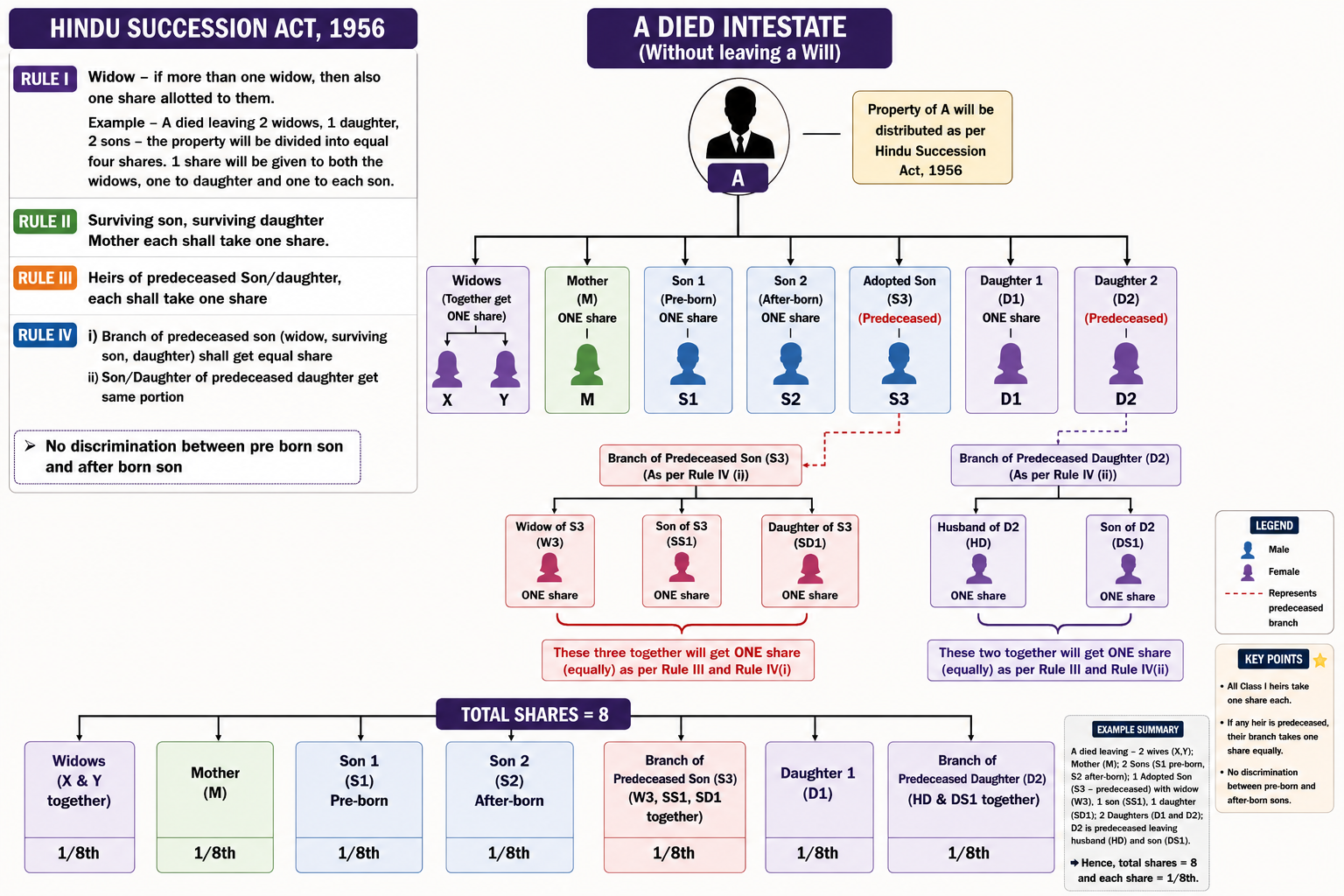
- Rule I: Widow - if there is more than one widow, they together take one share. Example: If 'A' dies leaving 2 widows, 1 daughter, and 2 sons, the property will be divided into 4 equal shares. One share will be shared equally between both widows, one given to the daughter, and one to each son.
- Rule II: Surviving sons, surviving daughters, and the mother shall each take one share.
- Rule III: The heirs of a predeceased son or predeceased daughter shall together take one share.
- Rule IV:
i) In the branch of a predeceased son, the widow (or widows together), surviving sons, and daughters shall get equal shares.
ii) In the branch of a predeceased daughter, surviving sons and daughters get equal portions.
· No discrimination is made between a pre-born son and an after-born son.
· Comprehensive Example: A died leaving behind: 2 wives (X, Y); Mother (M); 2 Sons (S1, S2 - 1 pre-born and 1 after-born); 1 Adopted Son (S3 - who is dead and has 1 daughter, 1 son, 1 widow); 2 Daughters (D1 and D2 - where one daughter is dead and leaves behind a husband and a son).
- Section 11 – Distribution among Class II heirs
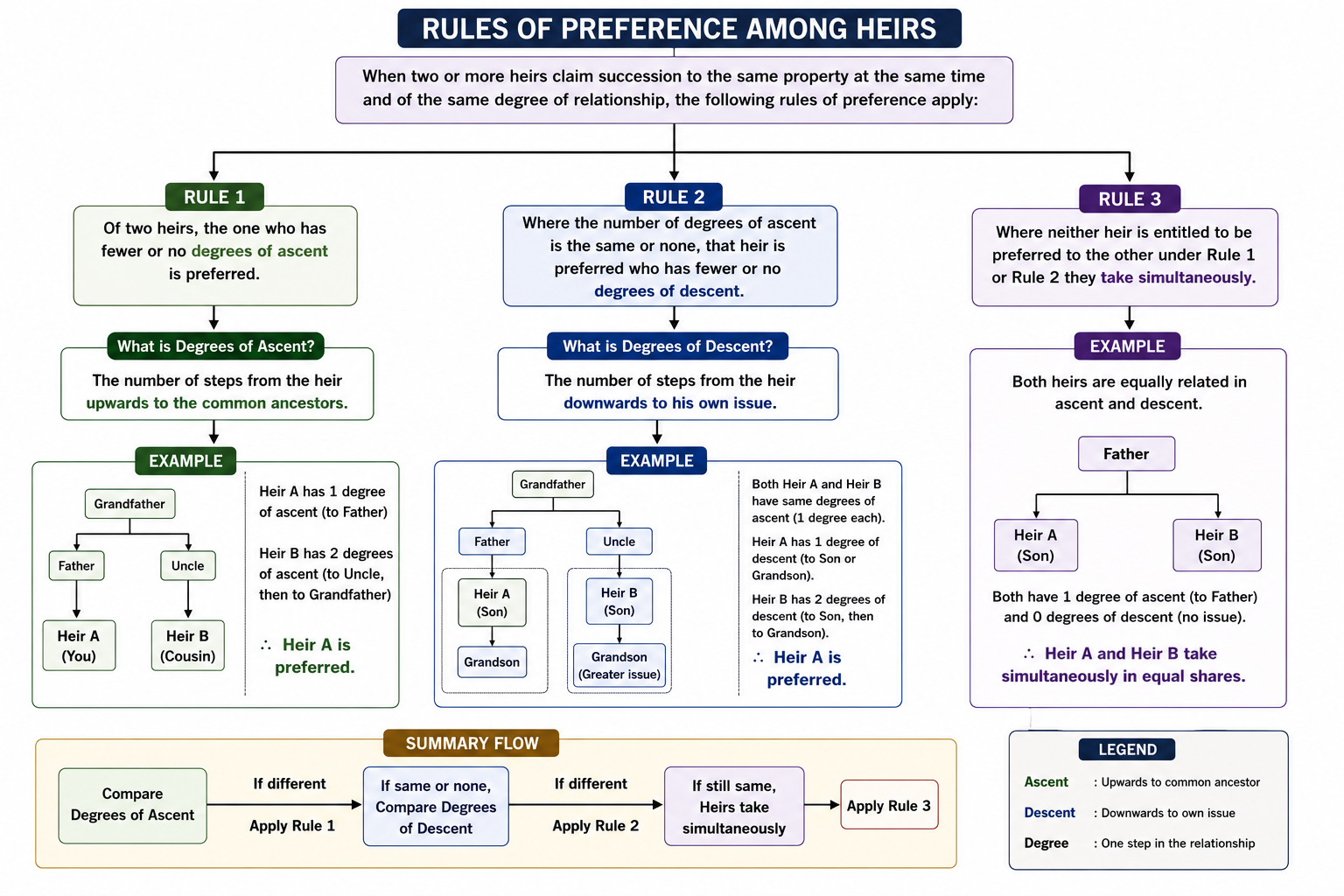
Distribution is done entry-wise, which means one entry at a time. Members listed within the same entry shall get equal portions. Property comes to Class II heirs only when no heirs are left in Class I. - Section 12 – Order of succession among agnates and cognates
2. Stridhan- Woman's Property & Female Succession
When a Hindu female dies intestate, it means she dies without leaving a valid will. In such cases, the distribution of her property is governed by Sections 15 and 16 of the Hindu Succession Act, 1956. Unlike the succession rules for a Hindu male, the Act provides a separate, distinct order of succession for females.
- Section 14 – Property of a female Hindu to be her absolute property
- Any property acquired by a female Hindu, whether before or after the commencement of this Act, shall be held by her as full owner and not as a limited owner.
- Earlier, women had absolute rights only over 'Stridhan', while other property devolved upon her with limited rights restricted to her lifetime. Upon her death, such limited property reverted to the heirs of the last full owner.
- 'Property' includes both movable and immovable assets acquired by inheritance, devise, partition, in lieu of maintenance, by gift from a relative or stranger, or by her own skill.
Mangal Singh vs Ratu
A Hindu widow was in possession of land belonging to her late husband. The property was illegally disposed of by the husband's collaterals in 1954. She brought a suit for possession, during the pendency of which the Hindu Succession Act was enacted, and the matter was subsequently decided in 1958.
JUDGEMENTThe Court held that as the woman became the absolute owner of the property under Section 14 of the Hindu Succession Act, her legal representatives had the absolute right to succeed to the property upon her death.
- Section 15 – General Rules of Succession in case of female Hindus
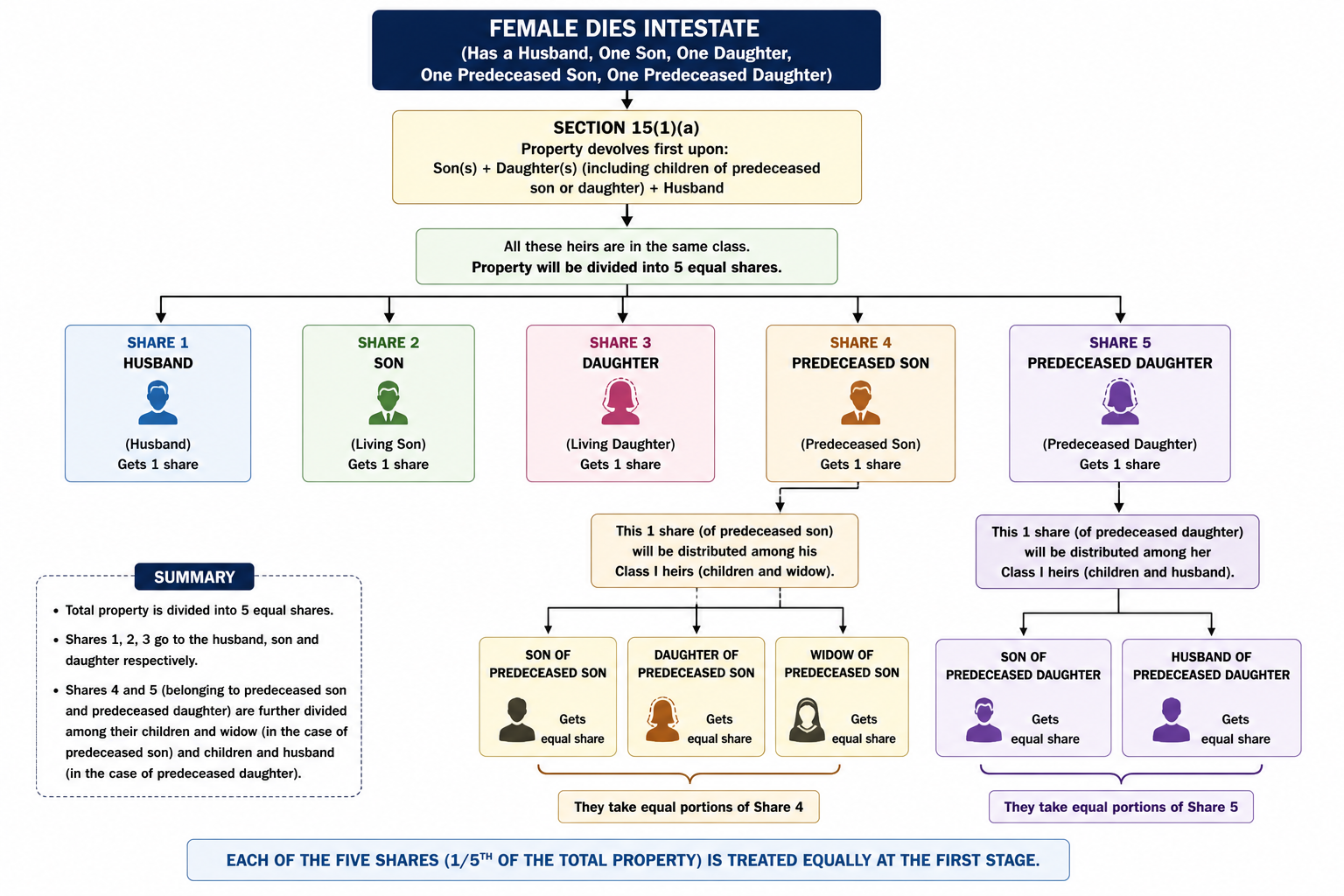
The property of a female Hindu dying intestate shall devolve according to the following order of priority:
a) Firstly - Upon the sons, daughters (including the children of any predeceased son or daughter) and the husband.
b) Secondly – Upon the heirs of the husband.
c) Thirdly – Upon the mother and father.
d) Fourthly – Upon the heirs of the father.
e) Fifthly – Upon the heirs of the mother.
Special Sub-sections / Exceptions:
· If a Hindu female inherited property from her father or mother and she dies without leaving any son, daughter, or children of a predeceased child, that property does not go to her husband's heirs. Instead, it goes to the heirs of her father.
Example: A inherits a house from her father. She dies without a husband, son, or daughter. The house will go to her father's legal heirs (e.g., her brother, sister, etc.), not to her husband's family.
· If a Hindu female inherited property from her husband or father-in-law and she dies without leaving any son, daughter, or children of a predeceased child, that property does not go to her parents' heirs. Instead, it goes to the heirs of her husband.
Example: A inherits agricultural land from her husband. She dies without children. The land will go back to her husband's legal heirs, not to her parents or their heirs.
Ayi Ammal V. Asari
K died intestate in July 1960. She was the widow of P. Her father had gifted her some property during her lifetime. She had sold some jewels, lent money earning interest, and held outstanding dues via promissory notes. K’s sister claimed that because K’s property originated as a gift from her father, she was entitled to inherit it under the special parental rule of Section 15.
JUDGEMENTThe Court held that property received as a gift could not be classified as property 'inherited' from parents under the special exceptions of Section 15. Hence, standard devolution rules under Section 15(1) applied, and the heirs of the husband took priority over the sister.
- Section 16 – Order of Succession and Manner of Distribution
- Rule 1: Among the heirs specified in sub-section (1) of Section 15, those in one entry shall be preferred to those in a succeeding entry, and those included in the same entry shall take simultaneously.
- Rule 2: If any son or daughter has predeceased the intestate, their children shall take among themselves the share which such son or daughter would have taken if living at the intestate's death.
- Rule 3: If the property of a Hindu female goes to the heirs of her husband, father, or mother, then it will be distributed according to the same succession rules that would have applied if that husband, father, or mother had died intestate immediately after her.
3. General Provisions Relating to Succession
The General Provisions Relating to Succession under Sections 18 to 30 of the Hindu Succession Act, 1956 lay down the common rules that govern inheritance after the legal heirs have been identified. These provisions deal with matters such as preference between full blood and half blood, the mode of distribution among heirs, the rights of a child in the womb, disqualifications from inheritance, and the devolution of property when no legal heir exists.
- Section 18 – Full blood preferred over half blood
- Heirs related to the deceased by full blood shall be preferred to heirs by half blood, provided the nature of the relationship is the same in all other aspects.
Illustration: A brother by full blood is preferred to a brother by half blood. However, a brother by half blood will be preferred to a son of a brother by full blood, because a brother is a nearer heir than a nephew.
Example: A married X and had two children, B and C. X died and A remarried Y, having one child D. C married W and had children C1 and C2. If B dies unmarried, his property is allotted to C at the first instance. If C is already dead, B’s property shall be shared among D (half-blood brother) and C’s children, since a brother excludes nephews. - Section 19 – Mode of succession of two or more heirs
- When two or more heirs inherit the property of an intestate together, they take the property:
· In equal shares (per capita basis), and
· As tenants-in-common, meaning each heir owns a separate, distinct, and individual share. - Section 20 – Right of a child in the womb
- A child who was in the womb at the time of the death of the intestate and who is subsequently born alive shall have the same right to inherit as if he or she had been born before the death of the intestate. - Section 21 – Presumption in cases of simultaneous deaths
- When two or more persons have died in circumstances rendering it uncertain which of them survived the other(s), it shall be presumed, until the contrary is proved, that the younger survived the elder.
Example: In the case of a tragic accident where a parent and child die together and it cannot be determined who passed first, the younger individual is legally presumed to have survived the elder. - Section 22 – Preferential right to acquire property in certain cases
- If a person dies intestate and two or more Class I heirs inherit the immovable property or business, and one of the heirs intends to transfer their share, the other Class I heirs have a preferential right to acquire that interest.
Example: A's wife, son, and daughter inherit a family house. If the son wants to sell his share, the wife and daughter have the first right to buy it.
- If the heirs cannot agree on the price, the Court will determine it upon application. If the applicant refuses to buy after the Court fixes the price, they must bear the associated court costs.
- If more than one Class I heir exercises their right to buy the share, the heir who is ready to pay the highest price or as determined by the court gets the preference. - Section 25 – Murderer disqualified
- Any person who commits murder or abets the commission of murder with the intention to inherit the property of the deceased shall be completely disqualified from inheriting the property. - Section 26 – Convert's descendants disqualified
- Where a Hindu has ceased or ceases to be a Hindu by conversion to another religion, children born to them after the conversion and their descendants shall be disqualified from inheriting the property of any of their Hindu relatives, unless such children or descendants are Hindus at the time when the succession opens. - Section 28 – Disease, defect, etc., do not disqualify
- Under old shastric laws, uncurable diseases, mental illness, or severe physical deformities disqualified a descendant. Disqualification on any such grounds has been completely removed by this Act. - Section 29 – Failure of heirs (Doctrine of Escheat)
- If an intestate leaves no heir qualified to succeed to their property under the provisions of this Act, such property shall devolve on the Government. However, the Government takes the property subject to all the liabilities and obligations that would have attached to it. - Section 30 – Testamentary succession
- Any Hindu may dispose of by will or other testamentary disposition any property which is capable of being so disposed of by him or her, in accordance with the provisions of the Indian Succession Act, 1925 or any other law for the time being in force.